BMI Compared with Body Fat Percentage as a Measure of Adiposity
BMI is a weight-for-height ratio that measures no fat at all. Body fat percentage measures adipose tissue directly. They correlate in populations but diverge in individuals.
BMI vs Body Fat Percentage: What Each Measures and Where They Disagree
A BMI of 24.9 and a body fat percentage of 14% can belong to the same person. Or to two people with opposite health profiles. The common wrong assumption is that BMI measures body fat and that a normal BMI guarantees a healthy body composition. Neither is true. Body mass index is a weight-for-height ratio. It measures no fat at all. Body fat percentage is the proportion of total body mass that is adipose tissue, measured by methods including DXA, BIA, skinfolds, and hydrostatic weighing. They correlate at population level. At individual level they diverge, especially in muscular individuals and older adults.
Body Fat Percentage Measurement Methods: Accuracy and Limits
No single measurement method produces a universal body fat percentage. Each method has a known error band, and results from different methods are not interchangeable.
Dual-Energy X-Ray Absorptiometry (DXA)
DXA distinguishes fat, lean, and bone mass. Its precision has a coefficient of variation of 1-2%, and its accuracy against a four-compartment model has a standard error of about 2-3%. It is a reference method in research, not a routine screening tool. A single scan takes 10-15 minutes. Book a scan at a university kinesiology lab or a commercial body-composition clinic. Expect to pay roughly $50 out of pocket.
Bioelectrical Impedance Analysis (BIA)
BIA estimates body composition by passing a small current through the body. Results are highly sensitive to hydration status and device algorithm. Standard error versus DXA is 3-5%, and individual errors at the 95% limits of agreement can reach ±8-10%. Take a reading before breakfast, after urination, and without alcohol the night before. Consumer scales using BIA add error by guessing limb geometry.
Skinfold Measurement
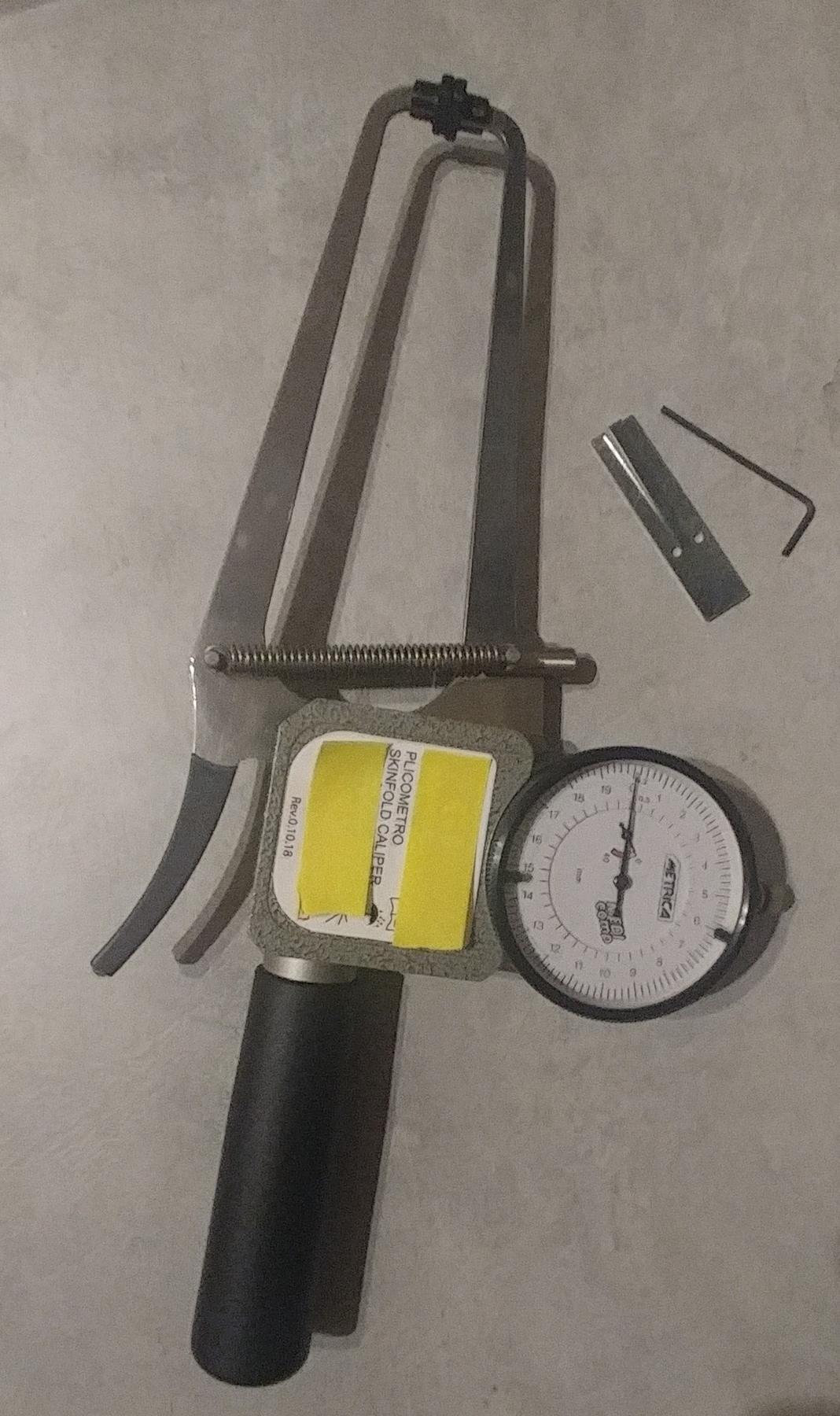
Calliper-based skinfold measurement estimates subcutaneous fat at defined sites. Accuracy depends on technician skill and the prediction equation chosen. Standard error versus DXA is 3-5%, and inter-rater error ranges from 2-5% body fat. A poorly trained measurer produces noise, not data. The three-site Jackson-Pollard equation loses accuracy in older adults and lean athletes. Book a measurer who does this daily, not someone who picked up callipers last month.
Hydrostatic Weighing
Hydrostatic weighing (underwater weighing) measures body density by comparing land weight to underwater weight. It was the historical reference method before DXA. Residual lung volume must be measured or estimated. Error is roughly 2-3% when done correctly. The procedure requires full submersion, which some people cannot tolerate.
BMI and Body Fat Disagreement: Who Gets Misclassified
A person can be overweight by BMI and not overfat. Or normal-weight by BMI and overfat. This divergence is not rare.
Muscular Individuals
BMI misclassifies adiposity in 20-40% of strength athletes because the formula cannot separate lean mass from adipose tissue. A rugby player at BMI 28 with 12% body fat is not overfat. BMI alone says they are overweight. Skip BMI for athletes, powerlifters, bodybuilders, and anyone with above-average lean mass.
Older Adults and Sarcopenia
In adults over 65, BMI underestimates adiposity in 10-30% of individuals. Sarcopenia, age-related loss of lean mass, reduces weight even as visceral adipose tissue increases. A 75-year-old with BMI 23 and 35% body fat has normal-weight obesity. Use waist circumference or waist-to-height ratio alongside BMI for anyone over 65.
Ethnicity and Adiposity at the Same BMI
At the same body fat percentage, South Asians have a BMI 3-6 kg/m² lower than Europeans. Black populations have a BMI 1-3 kg/m² higher at the same body fat percentage. The WHO Asian cut-offs from 2004 set increased risk at BMI ≥23.0 kg/m² and high risk at ≥27.5 kg/m². If you are South Asian, Chinese, or Japanese, the standard WHO bands do not apply to you.
| Attribute | BMI | Body Fat Percentage |
|---|---|---|
| What it measures | Weight-for-height ratio | Proportion of mass that is adipose tissue |
| Measurement method | Scale and stadiometer | DXA, BIA, skinfolds, or hydrostatic weighing |
| Population correlation with adiposity | r = 0.6–0.8 | Criterion method (DXA) has r > 0.95 with true fat |
| Individual misclassification rate | 20–40% in athletes, 10–30% in older adults | Method-dependent; BIA can misclassify ±8–10% at individual level |
| Universal healthy range | Yes: 18.5–24.9 kg/m² per WHO | No: ranges differ by method, sex, age, and population |
| Cost of measurement | Zero (self-reported) or free (clinician scale) | $50 for DXA; $20–100 for BIA; free to $50 for skinfolds |
| Time to obtain | 30 seconds | 2–15 minutes depending on method |
Overweight Not Overfat Definition: When BMI Misleads
The phrase "overweight not overfat" describes a person with a BMI ≥25.0 kg/m² whose body fat percentage is below the obesity threshold for their sex and method. In NHANES data, a significant fraction of overweight-BMI adults have normal body fat by DXA. The reverse also occurs: the Romero-Corral study from 2008 showed that roughly 20% of normal-BMI men and 30% of normal-BMI women had excess body fat by direct measurement, a condition called normal-weight obesity.
Normal Weight Obesity Body Composition
A person with normal-weight obesity has a BMI below 25.0 kg/m² but a body fat percentage above the obesity threshold for their sex and method. The body composition shows low lean mass and high adipose tissue. Risk for cardiometabolic disease in this group is comparable to people with a BMI in the obese range. The practical sign: a waist-to-height ratio above 0.5 combined with a normal BMI. If that fits you, BMI is not catching your risk. Use waist-to-height ratio or a body composition measurement instead.
Body Fat Percentage Healthy Range: Why No Universal Standard Exists
The American Council on Exercise publishes one set of body fat percentage healthy ranges: for men age 20-39, 8-19%; for women age 20-39, 21-32%. They classify obesity in men at ≥25% and in women at ≥32%. Essential fat minimums are 2-5% for men and 10-13% for women. These numbers do not apply across all measurement methods or all ethnic groups. A BIA reading and a DXA reading taken on the same person at the same time can differ by 3-5 percentage points. At the individual level, the 95% limits of agreement between BIA and DXA reach ±8-10%. The failure case: a consumer smart scale reports body fat at 22% for a woman, using its own algorithm, and she compares that to a DXA-derived chart. The two numbers are not equivalent. Never compare body fat percentages across different measurement methods. If you track changes, use the same method, the same time of day, and the same hydration state.
The Single Thing That Most Often Goes Wrong With BMI and Body Fat
The most common failure is treating a BMI number as a personal verdict on health. A BMI of 26 does not mean you are overfat. A BMI of 23 does not mean you are metabolically healthy. The proportion of lean mass, the location of your adipose tissue (visceral versus subcutaneous), and your bone mass all matter more than the weight-to-height ratio. A muscular individual at BMI 29 can have lower metabolic disease risk than a sedentary person at BMI 23 with excess body fat. No universal healthy-range standard for body fat percentage exists across all methods. A BMI number and a body fat percentage answer different questions. Neither alone is a metabolic health verdict.
More in this guide
Understanding BMI: A Guide to Body Mass Index Screening and Its LimitsHow the Quetelet Index Became Body Mass Index and a Global Screening ToolThe BMI Categories and the Evidence Behind Each Cut-Off.
Common Questions
Why does BMI disagree with body fat percentage for me?
BMI cannot distinguish lean mass from adipose tissue. If you have above-average muscle or below-average bone mass, your BMI number will misrepresent your body fat.
What is the most accurate way to measure body fat percentage?
DXA is the most accessible reference method, with a coefficient of variation of 1-2%. No consumer device matches it. For home tracking, skinfold callipers used by a trained measurer are better than BIA scales.
Can I have a normal BMI and still be overfat?
Yes. Normal-weight obesity affects roughly 20% of normal-BMI men and 30% of normal-BMI women. Use waist-to-height ratio (keep below 0.5) to catch this where BMI misses it.
What body fat percentage should I aim for?
No single number works across methods or populations. Use the ACE ranges as a starting point: 8-19% for men 20-39, 21-32% for women 20-39. Stay above essential fat minimums: 2-5% for men, 10-13% for women.