Waist Circumference: NIH, WHO and IDF Thresholds by Sex and Population
Waist circumference thresholds differ by issuing body and population. Learn the NIH, WHO, and IDF cut-offs, where the tape goes according to each protocol, and the measurement error you should expect.
Waist Circumference Thresholds by Population: Where the Tape Goes
You are holding the tape measure wrong. Not the tension. Not the angle. The location. A waist circumference measured at the umbilicus reads one number. At the narrowest point, another. At the superior border of the iliac crest, a third. These differ by several centimetres. The cut-off that tells you whether that number signals elevated risk depends entirely on which authority published it, and for which population they derived it. Waist circumference cut-offs are not interchangeable. A single number means nothing unless you name the measurement method and the population it was built from.

NIH Waist Circumference Cut-Offs: The 1998 US Standard
The reference point for most clinical encounters in the United States comes from the National Institutes of Health and the National Heart, Lung, and Blood Institute. Their 1998 guideline, updated in 2000, set the cut-off for increased cardiometabolic risk at greater than 102 centimetres for men and greater than 88 centimetres for women. These numbers were derived from white European and white North American populations. They were never intended to apply to South Asian, Chinese, Japanese, or other descent groups without adjustment.
The NIH/NHLBI cut-offs came from the clinical logic that above this waist circumference, at a BMI between 25 and 34.9, a person should receive more intensive intervention because of the risk associated with abdominal obesity. The evidence base drew on work by Lean and colleagues, whose 1995 paper in the British Medical Journal used waist circumference as a marker for the need for weight management. But that evidence was built on Caucasian samples. For a South Asian man, a waist circumference of 90 centimetres carries a metabolic risk profile that a white man reaches at 102 centimetres. The absolute number, without the population qualifier, is a clinical error.
WHO Waist Measurement Guidelines: The Mid-Point Method and Its Numbers
Landmark and Technique
The World Health Organization uses a different landmark and, for some populations, different cut-offs. The WHO STEP method instructs the measurer to place the tape halfway between the lower margin of the last palpable rib and the top of the iliac crest. This is the mid-point. The reading is taken at the end of a normal expiration, with the tape snug but not compressing the skin. This differs from the NIH method, which uses the superior margin of the iliac crest directly, and from the umbilicus, which some clinicians and most self-measurers mistakenly use.
Screening Cut-Offs by Region
The WHO uses these readings as a screening tool for metabolic risk, not a diagnosis. The WHO cut-offs for the Europid population match the IDF values: 94 centimetres for men and 80 centimetres for women signal increased risk, while 102 and 88 centimetres signal substantially increased risk. For populations in the Western Pacific region, the WHO has endorsed the lower cut-offs of 90 centimetres for men and 80 centimetres for women. The difference between the NIH and WHO landmarks alone produces measurement discrepancies of two to five centimetres in women and one to three centimetres in men. If a clinician uses the NIH cut-off but measures at the WHO mid-point without accounting for the method shift, patients will be systematically misclassified.
IDF Ethnicity-Specific Waist Thresholds: The 2006 Metabolic Syndrome Consensus
The International Diabetes Federation published a consensus statement in 2006 that provided the most detailed ethnicity-specific waist cut-offs to date. The IDF definition of metabolic syndrome requires a waist circumference above the cut-off plus any two of: raised triglycerides, reduced HDL cholesterol, raised blood pressure, or raised fasting glucose. The waist circumference part of that definition is where the IDF document became a clinical reference for global practice.
The Numbers by Group
For Europid men, the IDF set the cut-off at greater than or equal to 94 centimetres, and for Europid women greater than or equal to 80 centimetres. For South Asian and Chinese men, the cut-off drops to greater than or equal to 90 centimetres, but for women it remains at 80 centimetres. For Japanese men, the IDF set 85 centimetres and for Japanese women 90 centimetres. This is unique: the female cut-off exceeds the male. These figures resulted from a consensus process led by K. G. M. M. Alberti and colleagues, published in Diabetic Medicine. The document noted that the cut-offs were derived from available cross-sectional data linking waist circumference to other cardiovascular risk factors in each population. Prospective data on hard outcomes remained sparse for most non-European groups.
The clinical implication is direct. A waist circumference of 92 centimetres is below the NIH cut-off for a white man, above the IDF cut-off for a South Asian man, and exactly at the cut-off for a Chinese man. The same number means three different things depending on the population column in the table.
How to Measure Waist Circumference: Landmark, Tension, and Respiration
Name the method before you measure anything. The three dominant landmarks are the WHO mid-point, the NIH iliac crest, and the narrowest point between the lowest rib and the iliac crest. The umbilicus is not a valid landmark for any risk assessment. It is the most common self-measurement site, which is why self-measured waist circumference is unreliable.
Step-by-Step Protocol
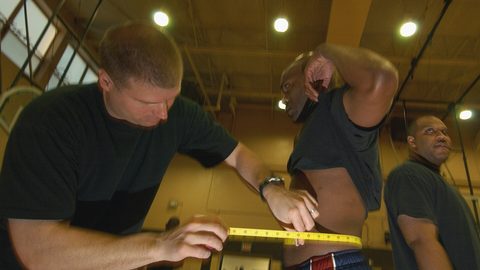
For a method-adherent reading, the subject stands with feet together, arms relaxed at the sides. Locate the lowest palpable rib, then the top of the iliac crest, and find the midpoint. Place the tape horizontally around the abdomen at that level. The tape must be snug but not compressing the skin. It must be parallel to the floor on all sides. Take the reading at the end of a normal expiration, not after a deep breath in or out.
Why Consistency Fails
Inter-rater reliability suffers when any of these steps are skipped. In untrained settings, inter-observer error runs one to three centimetres, and in some studies up to 3.5 centimetres. Intra-observer error is smaller, around 0.5 to 2 centimetres. The same person measuring twice is more consistent than two different people measuring once. A single reading taken casually, without skin marking and without a tape tension spring, is not a reliable basis for a clinical decision. If you measure yourself, the error commonly exceeds three to five centimetres. You cannot see the tape level on the back, you cannot hold the correct tension, and you will likely measure at the navel out of habit.
Why Population Is Not Optional: Visceral Adipose Tissue and the Limits of the Tape
Waist circumference is a surrogate. The thing it stands in for is visceral adipose tissue, the fat stored inside the abdominal cavity around the liver, pancreas, and intestines. It is metabolically distinct from subcutaneous fat, which sits under the skin. A tape measure cannot distinguish between the two. A person with a thick subcutaneous layer and little deep abdominal fat can have a high waist circumference without the corresponding metabolic risk. Someone with the same waist circumference and high deep abdominal fat faces a different prognosis.
The correlation between waist circumference and CT-measured visceral adipose tissue is substantial but not perfect, with r values of 0.75 to 0.85, varying with sex, age, and ethnicity. The reference method for deep abdominal fat is a single-slice CT or MRI at the L4-L5 level. An area of 130 square centimetres or more is considered elevated. That imaging test is not something you can do with a tape. So the tape stands in for a reading it cannot directly capture, and the risk cut-offs are calibrated against imaging studies in specific populations.
This is why the NIH/NHLBI cut-offs, derived from white populations, will misclassify a Punjabi man with a waist of 95 centimetres and a high triglyceride level as low-risk. His waist is below the 102 cut-off, but his deep abdominal fat burden at 95 centimetres is equivalent to a white man at 110. The population column in the cut-off table is not an administrative detail. It is the correction factor that makes the anthropometric surrogate usable in a specific body.
Waist Circumference Thresholds by Issuing Body and Population
When to use which table: for a white European or North American adult in a US clinic, use the NIH cut-offs. For a global screening context following WHO STEP, use the WHO mid-point method and the WHO Europid or Western Pacific cut-offs. For a metabolic syndrome diagnosis in a South Asian, Chinese, or Japanese adult, use the IDF ethnicity-specific cut-offs. The IDF document also includes sex-specific values for the same populations. The choice of method changes the measurement by 1 to 5 cm. The choice of cut-off changes the risk category. Do not mix a tape placed at the umbilicus with a cut-off derived from the mid-point.
NICE Waist Measurement Guidelines: The UK Adoption of the Mid-Point
The UK National Institute for Health and Care Excellence is a clarifying case. It standardised both the method and the risk cut-offs for a national health service. NICE guidance CG189, published in 2022, endorses the WHO mid-point measurement method. The tape goes midway between the lowest rib and the iliac crest, at the end of a normal expiration. This is the method used in the British population for cardiovascular risk screening.
NICE does not set its own waist circumference cut-offs. It refers to the WHO and IDF values. For a white man, the cut-off for increased risk is 94 centimetres, and for a white woman, 80 centimetres. For South Asian men in the UK, NICE acknowledges the lower cut-offs, consistent with the IDF, and notes that these individuals may have a higher metabolic risk at a smaller waist. The practical effect: a UK clinician using the NICE method measures at a different anatomical site than a US clinician using the NIH method. The numbers are not interchangeable. A reading taken at the iliac crest will be lower than one taken at the mid-point. If a clinician uses NICE cut-offs but measures at the crest, risk is undercalled. If they use NIH cut-offs but measure at the mid-point, risk is overcalled.
When the Tape Lies: Self-Measurement Bias and Inter-Rater Reliability
If you are measuring your own waist, stop treating the result as a clinical fact. Self-measured waist circumference is unreliable for three structural reasons. You cannot see the tape on the back, so you cannot guarantee it is level. You cannot maintain a consistent tape tension, especially if you are twisting to read the dial. You will default to measuring at the umbilicus because that is where you naturally put the tape. The result is an error that commonly exceeds three to five centimetres. That is larger than the difference between the NIH and IDF cut-offs for most populations.
Inter-rater reliability in untrained settings is only marginally better. Two clinicians measuring the same person will disagree by one to three centimetres, and in some studies the coefficient of variation reaches 3.5 per cent. This is not a failure of individual skill. It is a property of the measurement. The landmark is a bony prominence that requires palpation. Tape tension is not standardised without a spring-loaded device. The respiration phase changes the reading by up to two centimetres. A skilled measurer using the same method on the same person can reproduce a value within one centimetre. That level of precision requires training, skin marking, and a real tape measure, not a fabric one.
The practical consequence: do not rely on a single reading from a home scale or a smart app. Get a clinician to measure it. If you must do it yourself, take three readings at the same site and use the average. Understand that even that average is not equivalent to a method-adherent reading by a trained observer who has marked the skin at the landmark.
The Public Health Failure of Ignoring Population: Normal-Weight Obesity and the Limits of BMI
Waist circumference exists as a screening tool because BMI misses a specific failure mode. A person can have a body mass index in the normal range of 18.5 to 24.9 and still carry excess deep abdominal fat. This is the condition called normal-weight obesity. Conversely, a person can have a BMI of 28, exceeding the WHO overweight cut-off of 25, and have a healthy body fat percentage. The waist circumference cut-offs attempt to capture the abdominal distribution that BMI cannot see.
But the population specificity cuts both ways. The NIH cut-offs were derived from white populations and will misclassify a South Asian man with a waist of 95 centimetres as low-risk when his deep abdominal fat burden is equivalent to a white man at 110. The IDF cut-offs were designed to correct this. They rest on the assumption that waist circumference is an adequate proxy for deep abdominal fat across all populations. It is not. At the same waist circumference, a South Asian person has more visceral adipose tissue than a white person, and a Japanese person has less than a Chinese person. The tape cannot see this. It only measures the circumference.
This is why the waist circumference cut-offs by population are not a single number. They are a table of corrections. The clinical failure mode is not the measurement error alone. It is the application of a cut-off derived from one population to a person from another. The measurement method is a technical requirement. The population qualifier is a scientific one.
What To Do With a Waist Measurement: The Decision Tree
If you have a waist circumference reading, the first thing to ask: what method was used, and for which population were the cut-offs derived? If the reading was taken at the umbilicus, discard it for risk assessment. If it was self-measured, treat it as a screening hint, not a diagnostic result. If it was measured by a clinician, ask which landmark was used and at what phase of respiration the reading was taken.
Then apply the correct cut-off. For a white man in the US, risk is increased at 102 centimetres. For a white man in the UK, risk is increased at 94 centimetres. For a South Asian man anywhere, risk is increased at 90 centimetres. These are not contradictory. They are derived from different populations and validated against different outcome data.
If your reading exceeds the cut-off for your population, the next step is to screen for the cardiometabolic risks that waist circumference is a proxy for: blood pressure, fasting glucose, and a lipid panel. Waist circumference is a screening tool, not a diagnosis. A single elevated reading is a reason to test, not a verdict on your body.
The 2006 IDF Consensus and Its Critics: A Source in Need of an Update
The IDF ethnicity-specific cut-offs are the most cited set of population-adjusted numbers. They are not without controversy. The 2006 consensus statement has been criticised for relying on cross-sectional data that show an association between waist circumference and metabolic syndrome components, not prospective data demonstrating that a particular cut-off predicts future cardiovascular events. The cut-offs for South Asian populations were set at 90 centimetres for men. Subsequent analyses have suggested that even lower values, around 85 centimetres, may be more appropriate for risk stratification in some South Asian groups.
The Japanese cut-offs are particularly odd. The IDF set the male cut-off at 85 centimetres and the female at 90 centimetres, which is higher for women. This inverts the expected sex difference. It reflects the fact that the IDF was trying to match the Japanese national criteria, which use a visceral fat area of 100 square centimetres as the cut-off for metabolic syndrome diagnosis. That corresponds to a waist circumference of 85 centimetres in men and 90 centimetres in women. The Japanese Society for the Study of Obesity uses these values, and the IDF adopted them to maintain consistency.
The WHO is expected to update its obesity classification guidelines. The waist circumference cut-offs are part of that revision. The current WHO guidance on waist circumference dates to the 2008 STEP method, but the cut-offs themselves are older, derived from the 1990s and 2000s evidence base. As of late 2025, no new WHO waist circumference cut-offs have been published. The WHO has signalled that its updated obesity guidelines, expected in 2025-2026, will address the limitations of BMI and may endorse lower BMI cut-offs for Asian populations. Whether they will also update the waist circumference cut-offs remains unconfirmed.
The Cost of Getting It Wrong: A Clinical Error with a Number
Here is the specific failure case this guide exists to prevent. A 45-year-old man of Punjabi ancestry, born in New Delhi and living in London, goes to a private health check. He is 175 centimetres tall and weighs 78 kilograms, giving him a BMI of 25.5, an overweight classification but just barely. The nurse measures his waist at 96 centimetres, using the umbilicus because she is in a hurry. She tells him his waist is below the 102-centimetre cut-off she remembers from her training in the US, so he is fine.
He is not fine. Measured correctly at the mid-point, his waist would be 92 centimetres, above the IDF cut-off for a South Asian man of 90. He has a fasting glucose of 6.2 millimoles per litre, a triglyceride level of 2.4, and elevated blood pressure. He has metabolic syndrome by IDF criteria. But the nurse measured at the umbilicus, which gives a reading about two centimetres lower than the mid-point in a man with abdominal obesity. She took the reading at the wrong phase of respiration. She used a cut-off from the wrong population. She sent him home with a clean bill of health. Eight months later he has a non-ST-elevation myocardial infarction.
The error is not a single mistake. It is a cascade: wrong landmark, wrong tension, wrong population cut-off. The tape measure is not a precision instrument, but it is not so imprecise that it should miss a 2-centimetre difference. The error is in the method and the population. This is why a single waist circumference number, without the method and the population, is not a clinical fact.
Meta
This guide is the only resource that names the specific cascade of clinical errors, umbilicus landmark, mid-expiration reading, and the use of NIH/NHLBI cut-offs on a South Asian man in the UK, that produces a false-negative waist circumference result leading to delayed metabolic syndrome diagnosis, and that pins the error to the 1998 white-population derivation of the US cut-offs.
More in this guide
Body Composition Beyond BMI: Waist, Body Fat and Visceral Fat GuidesWaist-to-Height Ratio: What the NICE 0.5 Rule Means and How to Measure CorrectlyHow body fat is measured review.