Why BMI and Waist Measurements Can Give Different Views of Health
Understand why BMI and waist measurements can differ, with UK thresholds, muscle mass explained and clear steps for measuring your waist accurately.
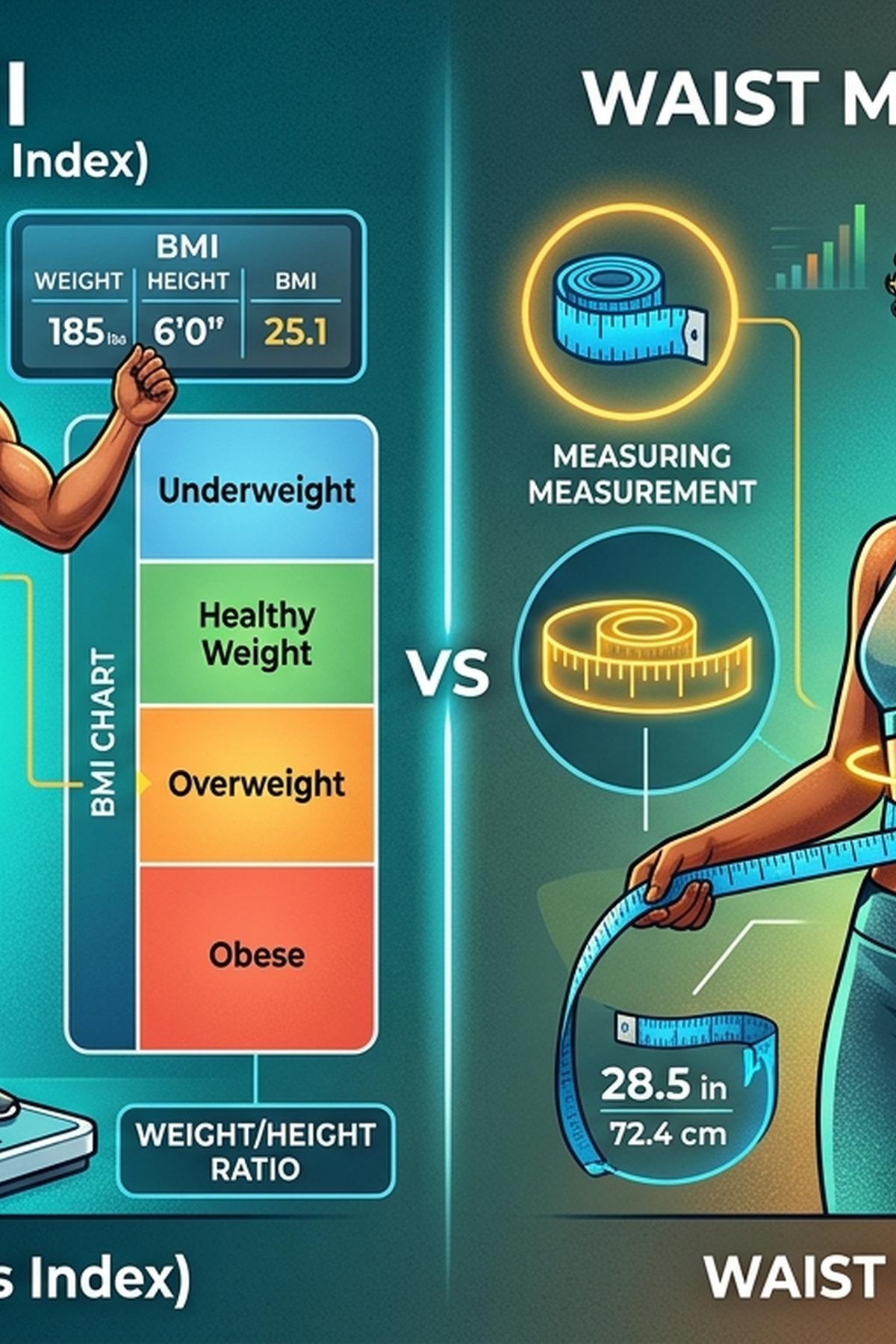
Your BMI falls within the healthy weight range, but your waist measurement suggests increased health risk. Or your BMI sits in the overweight category, despite years of strength training and a relatively small waist. These results can feel confusing. Yet both can be accurate, because they describe different features of your body. Understanding that difference makes the numbers more useful and less personal.
BMI and waist-to-height ratio answer different questions about body size.
- BMI relates your total weight to your height, without separating muscle from fat.
- Waist-to-height ratio adds information about fat carried around your middle.
- Both are screening measures. Neither provides a complete assessment of your individual health.
BMI Measures Weight Relative to Height
Body mass index, usually shortened to BMI, uses two measurements: weight and height. The calculation divides weight in kilograms by height in metres squared. For example, someone weighing 75 kg at a height of 1.75 metres has a BMI of about 24.5.
BMI is useful because it gives a consistent way to describe weight relative to height. A weight of 75 kg means something different for a person who is 1.50 metres tall than for someone who is 1.90 metres tall. BMI accounts for that height difference, although it cannot account for every difference in body shape or build.
The usual adult categories are below 18.5 for underweight, 18.5 to 24.9 for healthy weight, 25 to 29.9 for overweight, and 30 or above for obesity. These are screening categories. They describe patterns of risk across groups rather than a sharp boundary between health and illness.
Thresholds also need context. As explained in adult weight guidance, UK practice uses lower thresholds for people from South Asian, Chinese, other Asian, Middle Eastern, Black African or African-Caribbean backgrounds. Overweight starts at BMI 23 and obesity at 27.5, because health risks can occur at lower BMI levels in these groups.
Waist-to-Height Ratio Adds Information About Your Middle
Waist-to-height ratio divides your waist circumference by your height. Both measurements must use the same units. A waist of 85 cm and height of 170 cm gives a ratio of 0.50.
This measure shifts attention from total body weight towards central adiposity, the term used for fat carried around the abdomen. It adjusts waist size for height, which helps explain why a single waist circumference does not mean the same thing for every person.
UK assessment guidance recommends using waist-to-height ratio alongside BMI in adults whose BMI is below 35. Its categories are 0.40 to 0.49 for healthy central adiposity, 0.50 to 0.59 for increased central adiposity, and 0.60 or above for high central adiposity. The latter categories carry increased and further increased health risks respectively.
These waist-to-height categories apply across sexes and ethnicities, including adults with high muscle mass. The practical message is to keep your waist below half your height. A result below that threshold does not guarantee freedom from illness, and a lower result is not automatically a reason to keep reducing your waist.
What Each Measurement Can Tell You
| Feature | BMI | Waist-to-Height Ratio |
|---|---|---|
| Measurements used | Weight and height | Waist circumference and height |
| Main focus | Total weight relative to height | Abdominal size relative to height |
| Main limitation | Cannot separate muscle, fat, bone or fluid | Cannot directly measure internal fat or diagnose disease |
| Useful question | Does my weight warrant further assessment? | Does my waist suggest greater central fat accumulation? |
Muscle Mass Can Push BMI Up Without a Larger Waist
A kilogram of muscle adds the same amount to your weight as a kilogram of fat. BMI treats them identically within its calculation. It has no way to identify what makes up those kilograms.
Consider two adults who are both 1.80 metres tall and weigh 90 kg. Each has a BMI of about 27.8. One may have substantial muscle from resistance training. The other may have less muscle and more body fat. Their matching BMI results do not establish matching body composition.
If their waists measure 81 cm and 99 cm, their waist-to-height ratios are 0.45 and 0.55. These hypothetical results show how waist measurement can add information that BMI misses.
This does not mean every physically active person can dismiss a raised BMI. Having strong muscles does not prevent abdominal fat accumulation. Training history is useful context, but it cannot replace measuring or checking other health markers.
Fat Distribution Can Change the Picture at the Same BMI
People store fat in different places. Subcutaneous fat sits beneath the skin. Visceral fat lies deeper in the abdomen around internal organs. Greater visceral fat accumulation is associated with metabolic problems, including impaired blood glucose regulation.
A tape measure cannot separate those fat compartments. It measures the outside of your abdomen, including tissues other than fat. Waist-to-height ratio is therefore an indirect clue about central fat, rather than a scan of what is happening inside.
This helps explain why a person can have a BMI in the healthy weight range and still have a raised waist-to-height ratio. Their total weight may be relatively modest, but more of their fat may sit around their middle. Lower muscle mass can also leave BMI looking unremarkable despite a less favourable body composition.
Genetics, age and hormonal changes can influence fat distribution. Your body can change shape without a large change on the scales. That is one reason a stable weight does not always tell the whole story.
Start With Reliable Measurements Before Interpreting Results
Using a BMI calculator can provide a starting point. Enter a recent weight and an accurately measured height. Then consider whether your muscle mass, family background or circumstances affect how that result should be interpreted.
For weight, place your scales on a firm, level surface. Remove shoes and heavy clothing. For height, stand without shoes against a suitable vertical surface, look straight ahead and use a flat headpiece. A remembered height or a weight taken while carrying a heavy bag can introduce avoidable error.
Waist measurement deserves the same care. Clothing size is not a substitute, because sizing varies between garments and manufacturers.
Find the Correct Position for the Tape
Stand upright with your abdomen relaxed. Find the bottom of your ribs and the top of your hip bones. Place a flexible, non-stretch tape around your middle halfway between those points. This is usually just above the belly button, although the landmarks matter more than the belly button itself.
Keep the tape horizontal around your body. A mirror or another person can help you check the position at the back. Measure against bare skin where possible. The tape should sit snugly without pressing into your skin.
Read After a Natural Breath Out
Breathe normally, then read the measurement after breathing out naturally. Avoid sucking in your stomach, bracing your abdominal muscles or forcing out every last breath. Those actions change what you are measuring.
Repeat the measurement to check your technique. If the readings differ noticeably, reposition the tape and try again. Use the same method and broadly similar conditions when tracking changes over time.
Use Matching Units and Avoid False Precision
Divide waist circumference by height using centimetres for both, or inches for both. For someone 168 cm tall with an 84 cm waist, the calculation is 84 divided by 168, giving 0.50.
A 1 cm difference in that person's waist changes the ratio by about 0.006. This is a calculated example, not a universal measurement error estimate. It shows why a result close to a threshold should prompt careful remeasurement rather than alarm. Risk does not suddenly jump because a rounded result moves from 0.49 to 0.50.
Neither Number Can Determine Your Individual Health
BMI and waist-to-height ratio are screening tools. They cannot measure blood pressure, cholesterol, blood glucose, fitness, nutritional adequacy or mental wellbeing. A reassuring result cannot rule out disease. A raised result cannot diagnose it.
A clinician may consider both measurements alongside symptoms, medical history, medicines, family history and relevant tests. Someone with a higher BMI and smaller waist may need a different discussion from someone with a lower BMI and larger waist. Neither person benefits from assumptions based on appearance.
These adult thresholds also have limits. Children and teenagers need age-appropriate BMI interpretation using growth centiles. Pregnancy changes weight and abdominal size, making these ordinary comparisons unsuitable. Fluid retention, abdominal swelling and conditions affecting height can complicate interpretation too.
If either measurement causes concern, discuss it with a GP or another qualified health professional. Unexplained weight changes or persistent abdominal swelling deserve assessment rather than repeated calculator checks. If measuring triggers distress or compulsive checking, professional support can help you assess health without relying on frequent measurements.
Two Measurements Can Support a Better Conversation
Different BMI and waist results usually reflect different questions being asked. BMI describes weight relative to height. Waist-to-height ratio adds a view of abdominal size. Muscle mass can raise one without raising the other, while central fat accumulation can make waist size more concerning despite a BMI within the usual healthy range.
Use accurate measurements, interpret thresholds with context, and treat unexpected results as a reason to ask questions. The aim is a clearer understanding of your health, supported by the wider evidence about your body and your life.