Body Fat Percentage Calculator Using the US Navy Circumference Method
Calculate your body fat percentage using the US Navy circumference method and learn how the estimate compares to DXA, including who it reads worst for.
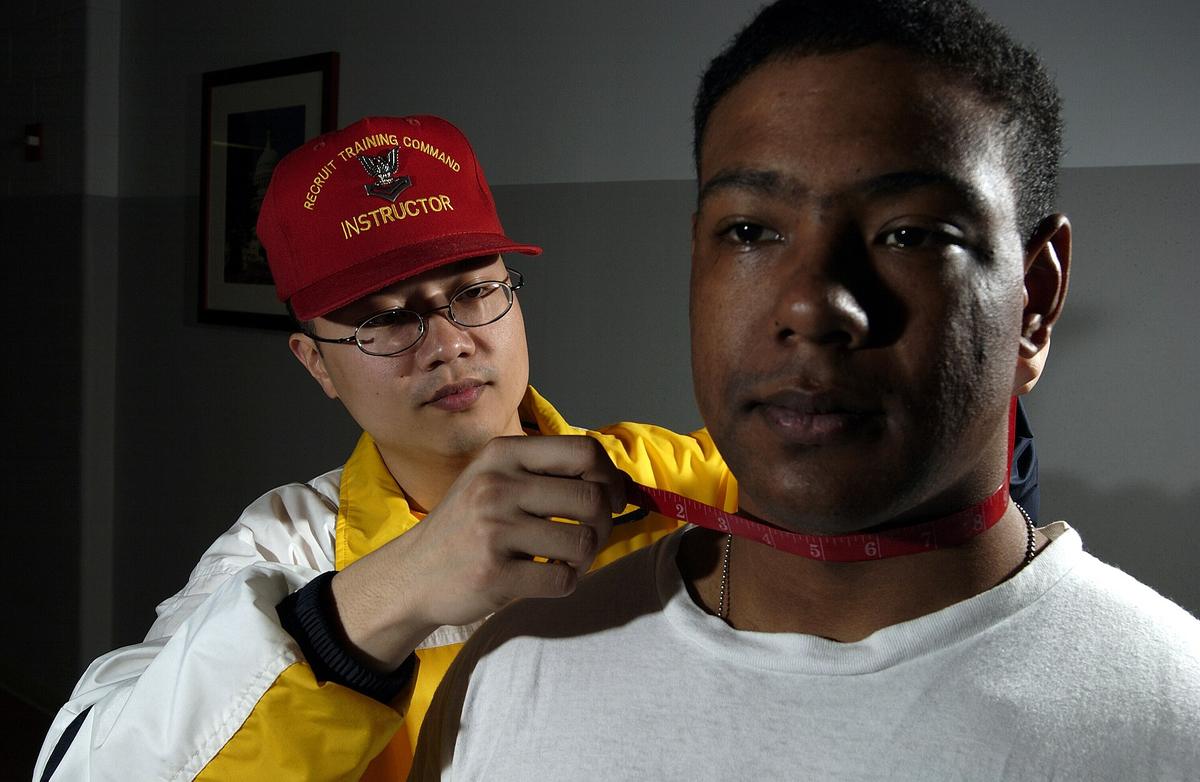
_aboard_RTC.jpg)
Body Fat Percentage Calculator Using the US Navy Circumference Method
Stand in front of a mirror with a non-stretch tape measure. The US Navy method estimates your body fat percentage from three tape readings. Use the calculator and learn exactly where the tape goes, how large the individual error is against DXA, and for whom the number is least reliable.
The Hodgdon-Beckett equations from 1984, derived from 602 men and 135 women in the U.S. Navy, power this calculation. The method estimates from circumference. It does not measure fat directly. It works for many body types but fails systematically for very muscular individuals and older adults with sarcopenia.
- Method: US Navy circumference method (Hodgdon-Beckett, 1984)
- Men's formula: %BF = 86.010 × log₁₀(abdomen − neck) − 70.041 × log₁₀(height) + 36.76
- Women's formula: %BF = 163.205 × log₁₀(abdomen + hip − neck) − 97.684 × log₁₀(height) − 78.387
- Standard error (men): ±3.5% body fat
- Standard error (women): ±3.6% body fat
- Correlation with hydrostatic weighing (men): r = 0.90
- Correlation with hydrostatic weighing (women): r = 0.85
- DXA vs. 4-compartment model error: approx. ±1.5-2.5% body fat
- ACE healthy ranges (men): 18-24% body fat
- ACE healthy ranges (women): 25-31% body fat
How To Take Each Measurement According to the US Navy Protocol
Your tape placement makes or breaks the estimate. Use a non-stretch tape. Measure against bare skin, not clothing. Take each reading three times and average them.
Neck
Stand looking straight ahead. Place the tape just below the larynx, at the level where the neck has the smallest girth. Pull the tape snug without compressing the skin. Record to the nearest 0.5 centimetre.
Abdomen
For men and women: measure at the level of the navel. The tape must be horizontal. Breathe out normally. Do not suck in or push out. Record the reading at the end of a normal exhalation.
Hip (women only)
Measure at the widest point below the iliac crest. This is the level of the greater trochanter. Keep the tape horizontal. Record the maximum girth.
Height
Measure barefoot against a wall. Stand with heels together, back straight, and look straight ahead. Record height in centimetres.
Healthy Body Fat Ranges: ACE and NIH/WHO Standards
No single set of ranges applies to every method and every population. The American Council on Exercise (ACE) publishes the most widely used reference in fitness settings. The NIH/WHO ranges come from Gallagher et al. (2000), a study of 1,626 multi-ethnic adults in New York City.
ACE body fat ranges
The ACE Personal Trainer Manual gives these categories:
Men: essential fat 2-5%, athletes 6-13%, fitness 14-17%, acceptable 18-24%, obesity ≥25%.
Women: essential fat 10-13%, athletes 14-20%, fitness 21-24%, acceptable 25-31%, obesity ≥32%.
NIH/WHO body fat ranges (Gallagher et al. 2000)
Men: underfat <8%, healthy 8-19%, overfat 20-24%, obese ≥25%.
Women: underfat <21%, healthy 21-32%, overfat 33-38%, obese ≥39%.
These ranges used DXA and hydrostatic weighing as reference methods. They are not interchangeable with Jackson-Pollock skinfold ranges, BIA device readouts, or the US Navy method estimate. A BIA scale number and a DXA number are not interchangeable. The method matters.
| Age group | Lean | Ideal | Average | Overfat |
|---|---|---|---|---|
| 20–29 | <11% | 11–16% | 17–21% | >21% |
| 30–39 | <13% | 13–18% | 19–23% | >23% |
| 40–49 | <15% | 15–20% | 21–25% | >25% |
| 50–59 | <17% | 17–22% | 23–27% | >27% |
| 60+ | <19% | 19–24% | 25–29% | >29% |
Body Fat Estimate Accuracy: How Large Is the Error Against DXA?
The US Navy method estimates body fat from circumference equations. It does not measure fat directly. The Hodgdon-Beckett study reported a standard error of estimate of ±3.5% body fat for men and ±3.6% for women against hydrostatic weighing. DXA, the reference method used in most modern studies, has a standard error of approximately ±1.5-2.5% body fat against a four-compartment model, and same-day repeat precision of ±0.5-1.0%.
For an individual, the US Navy estimate can be off by 5-8 percentage points compared to a DXA scan. The error is not random. It is systematic for certain body types.
Who gets the worst reading
Very muscular individuals: the circumference method cannot distinguish subcutaneous fat from muscle mass. A bodybuilder with low body fat but a large neck and abdomen will read artificially high. Older adults with sarcopenia: loss of muscle mass reduces circumference, so the method underestimates body fat. The same BMI number can mean different body composition at different ages, and the US Navy method does not correct for this.
Individual misclassification risk
The method's correlation with hydrostatic weighing is r = 0.90 for men and r = 0.85 for women. That is good at a population level but leaves substantial variance at the individual level. For tracking changes over time, the method is acceptable provided you use the same protocol every time. For a single accurate number to compare to a DXA reference, skip this method.
What This Body Fat Calculator Does Not Do
This calculator does not measure visceral adipose tissue. Waist girth is a surrogate for abdominal fat, but it cannot distinguish subcutaneous fat from visceral fat. CT or MRI is required for that. The method does not account for hydration status, which affects all circumference-based estimates, nor for ethnic differences in fat distribution.
The US Navy method gives you a number useful for tracking general trends. A DXA scan is the only way to get a reference-quality body fat percentage. If you cannot get a DXA scan, use this calculator knowing the individual error is real and the number is an estimate, not a diagnosis. Never use a single BIA reading taken under uncontrolled conditions as if it were a measurement.
Common Questions
How does the US Navy method compare to skinfold measurement?
Skinfold measurement uses callipers at specific sites and estimates subcutaneous fat. The US Navy method uses circumference only. Both have individual error. Skinfold accuracy depends entirely on technician skill. The US Navy method is easier to self-administer but cannot account for fat distribution differences.
Can I use this calculator if I am pregnant?
No. Pregnancy changes circumference readings in ways the equations were not designed to handle. The estimate will be meaningless. Use a different method or wait until after delivery.
Is the US Navy method accurate for athletes?
It is less accurate for very muscular athletes. The circumference method cannot distinguish muscle from fat. A bodybuilder will get a falsely high estimate. For lean athletes with low muscle mass, it may read low. The standard error of ±3.5% applies to a general population, not to extreme body types.
How often should I take the measurement?
Once every two to four weeks under the same conditions: same time of day, same hydration status, same tape. More frequent measurement introduces noise from daily fluid shifts. Do not compare a morning reading to an evening one.
What is the difference between the ACE range and the NIH/WHO range?
ACE ranges are from the ACE Personal Trainer Manual and are widely used in fitness. NIH/WHO ranges come from Gallagher et al. (2000) and are based on a multi-ethnic sample. The two systems have different cut-offs. Choose one and stick with it for tracking.
Can I use this calculator for children?
No. The Hodgdon-Beckett equations were derived from adult Navy personnel. They do not apply to children. Paediatric body fat estimation requires age- and sex-specific growth charts and different methods.
What is the single most common mistake people make with this method?
Measuring the abdomen at the wrong landmark. The protocol specifies the navel level, not the narrowest point of the waist or the level of the belly button. A reading taken at the narrowest waist will give a different, lower estimate. Use the navel.